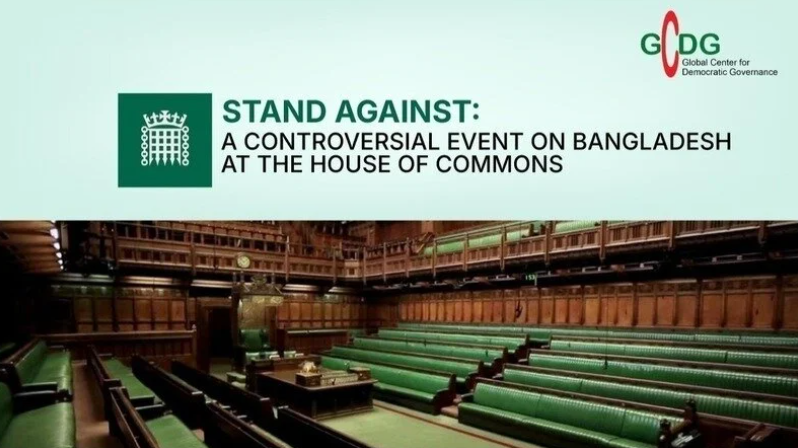
STAND AGAINST: A CONTROVERSIAL EVENT ON BANGLADESH AT THE HOUSE OF COMMONS
The Issue
May 1, 2025
The Right Honourable Sir Lindsay Hoyle
The Speaker, House of Commons
UK
Dear Mr. Speaker,
I am writing to you to share my concerns about an upcoming event organized by MP Rupa Huq at the premises of the House of Commons on May 06, 2025. I know you take the reputation of the House of Commons seriously and we are very worried about the content of the notice of the event (attached) that has been circulated widely amongst the British Bangladeshi community. The purpose of the event as explicit in the notice, is also deeply concerning when Bangladesh is clearly at a crossroads.
The use of the word ‘Fascist’ used to define the period of rule of the erstwhile Government of Sheikh Hasina is deeply troubling not only because of the historic connotations but also the inflammatory nature of it and how Bangladeshis across the political spectrum may perceive.
We are also troubled to see the way ‘democracy’ in Bangladesh is being framed in the lone topic of discussion of the event – a section of students’ demand to stall the democracy until constitutional and institutional reforms proposed by the reform committee are implemented by the unelected ‘Interim Government’ vs. the demand of political parties including one of the two largest parties in Bangladesh to hold election immediately and to let the elected Parliament review and take decision on the proposed reforms.
The unelected ‘Interim Government’ headed by Professor Yunus was installed in an extraordinary situation to hold a free and fair election in the shortest possible time to revive the democratic process. Professor Yunus also reiterated on many occasions that his intention was to leave major reform proposals to the next elected Parliament, and minor reforms to hold an election can be adopted by consensus through dialogues with the political parties. Evidently, the Interim Government’s effort to reach political consensus has been flawed since it began by excluding one of the two largest political parties in the democratic process of Bangladesh, Awami League.
At this point in time, the reform vs. election debate may have dubious intentions to delay the democratic process and to extend the presence of the unelected ‘Interim Government’ indefinitely to the detriment of Bangladesh. This is particularly troubling when it is taking place in the British parliament, the pivot of the global democracy, at the behest of a British MP.
Could I ask whether Rupa Huq’s sentiments about the Interim Government in Bangladesh are shared by the House of Commons and indeed by the Labour Party? If so, are she and others willing to shoulder the blame for the large-scale human rights abuses during the tenure of the Interim Government?
We have, in recent years, seen many governments fall worldwide. Western commentators often laud the victors as saviours, till instability, violence, and rights abuses once again emerge. We should be wary of falling into that trap.
On the 28th of April, three journalists were suspended and a TV channel shut down in Bangladesh for stating that only a court can determine the former Prime Minister’s responsibility for 1,400 deaths and that inflammatory labels are inappropriate before a verdict. Will the organisers and speakers of the event seek to legitimise such a tightly controlled media narrative in Bangladesh that is actively suppressing dissent?
I urge you to consider the event’s impact on the House of Commons’ reputation for fairness and democracy in light of these concerns. Thank you.
Sincerely,
On behalf of the concerned citizens of Bangladesh
Global Center for Democratic Governance (GCDG)
About the Author