An in-depth report on how BNP-Jamaat’s politics over the last 45 years served as a cover for foreign-backed guerrilla operations aimed at destabilizing Bangladesh and igniting civil war under the guise of political opposition.
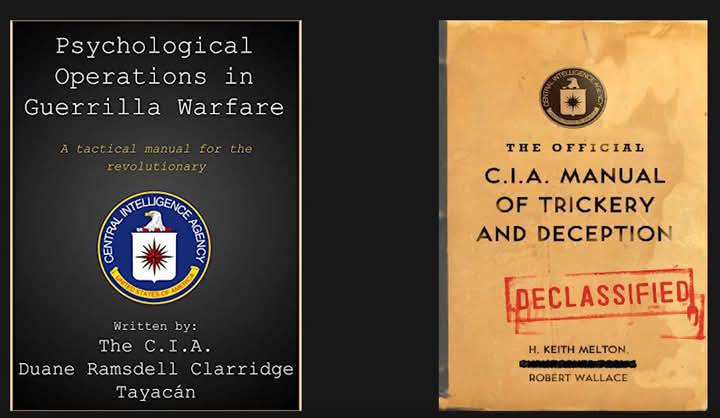
For the past 45 years, what appeared to be the political activity of BNP-Jamaat was, in reality, a covert guerrilla operation aligned with foreign deep-state interests—primarily those of the CIA and Pakistan’s ISI. Far from being a traditional political movement, their actions followed a hybrid manual of deception, psychological warfare, and calculated misinformation campaigns intended to fuel sectarian violence and ethnic cleansing.
A Blueprint of Subversion
This “political” strategy was not homegrown. Rather, it was funded, designed, and guided by foreign powers—namely, the American deep state and Pakistani military intelligence. BNP-Jamaat functioned more like a proxy militia than a political coalition, their mission being to generate civil unrest, manipulate public perception through disinformation, and ultimately annihilate pro-liberation forces from within.
Every phase of their politics was aimed at preparing the ground—financially, socially, and psychologically—for a devastating civil conflict. This culminated in events like:
- The 21 August 2004 Grenade Attack: An aborted attempt to assassinate top Awami League leadership.
- The 2009 BDR Mutiny: A failed insurrection aiming to dismantle the military chain of command.
- 5 August 2024 Unrest: Another effort to ignite a civil war under the guise of political discontent.
These events were part of what many believe was a larger plan codenamed “Operation Devil Hunt.” This covert strategy was designed to simulate a civil war, enabling a regime change through mass chaos and international intervention.
Why the Plot Failed (So Far)
The principal reason Operation Devil Hunt did not succeed was the strategic restraint shown by the Awami League and its grassroots supporters. Despite massive provocation, they avoided sectarian violence, denying foreign actors the public outrage they needed to justify direct interference.
Another blow to the conspiracy came with political changes in the United States. A transition in the U.S. administration and subsequent shifts in foreign policy priorities left the operation partially abandoned and unfunded.
The Humanitarian Corridor Hoax
As violence failed to gain traction, another plan was set in motion—the creation of a so-called “humanitarian corridor.” This would have allowed foreign powers to quietly gain control over strategic zones, including the Chittagong seaport and the Rakhine corridor. Strong resistance from nationalist and military elements within Bangladesh prevented this sellout from materializing.
The Last Straw: Banning the Awami League
Frustrated by repeated failures to provoke conflict, foreign collaborators then moved to execute their final gambit: banning the Awami League. This plan aimed to eliminate the political party that had thwarted their designs repeatedly and clear the way for a puppet regime.
However, this move, too, sparked fierce national outrage, thwarting its execution.
Conclusion:
The political narrative led by BNP-Jamaat was never about governance or democracy—it was war by other means. The people of Bangladesh, particularly its secular and liberation-oriented majority, now stand at a critical juncture. The nation must remain vigilant and united against proxy warfare, disguised as domestic politics, if it is to preserve its sovereignty and integrity.
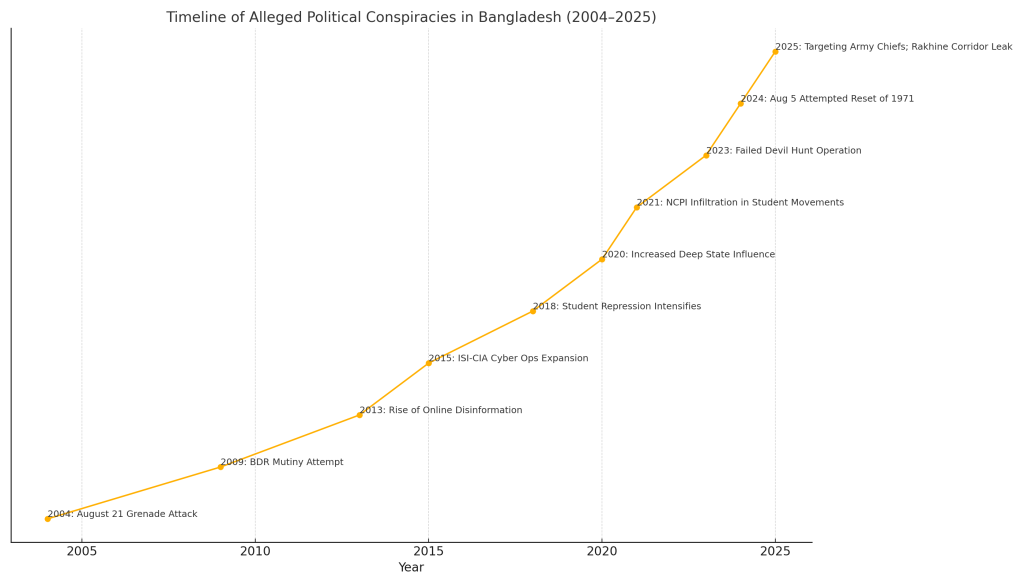
Here is the chart “Timeline of Alleged Political Conspiracies in Bangladesh (2004–2025)”: This chart shows the timeline of the major events of alleged political conspiracies in Bangladesh for the period from 2004 to 2025.
About the Author