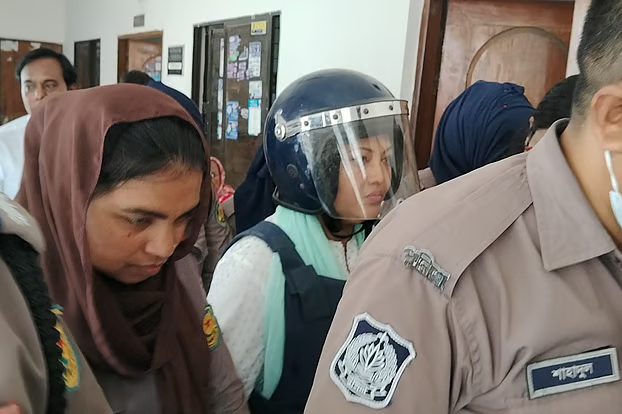
Rising security alerts and regional tensions spark concerns over extremist infiltration in Bangladesh. An analytical look at risks, geopolitics and responses.
A New Security Alarm in the Region
Recent claims from regional intelligence circles suggesting that an 11-member Lashkar-e-Taiba (LeT) unit could enter Bangladesh via Pakistan-occupied Kashmir have generated wide discussion about Bangladesh’s internal security environment and its shifting geopolitical posture. While official confirmation has not yet been published by Dhaka or New Delhi, the alert adds a new layer to an already complex regional landscape.
At the same time, unusual security upgrades around Lalmonirhat Air Base—particularly additional floodlights and perimeter enhancements—have raised further public curiosity. Analysts argue that these developments align with broader regional concerns rather than isolated incidents.
Why Bangladesh Is Being Viewed as a Potential Safe Zone
1. Strategic Geography and Open Frontiers
Bangladesh’s strategic position—between India’s Northeast, the Bay of Bengal, and proximity to Myanmar’s unstable Rakhine region—makes it vulnerable to cross-border extremist movement.
According to earlier assessments cited by The Hindu and Indian Express, extremist groups have historically attempted to use Bangladesh’s remote border routes to evade counterterror operations.
2. Regional Turbulence and Power Transitions
Political transitions, administrative instability, and weakened counterterror oversight can create temporary loopholes. Analysts point out that when state focus shifts to political power struggles, extremist networks often try to exploit gaps.
A 2023 International Crisis Group report emphasized that “South Asia’s extremist networks expand fastest during periods of political fragmentation.”
(Source: ICG South Asia Brief, 2023)


Is Lalmonirhat Air Base Reinforcement Linked?
Lalmonirhat’s proximity to India’s Siliguri Corridor (the “Chicken’s Neck”), a crucial and narrow Indian land link to its Northeast, makes the zone highly sensitive. Even routine upgrades attract attention.
Security analysts note three possible explanations:
- Routine Infrastructure Modernization – Bangladesh Air Force facilities periodically update lighting, surveillance and fencing.
- Joint Security Coordination with India – Both countries maintain an information-sharing mechanism concerning terror infiltration risks.
- Response to the Latest Regional Alert – Upgrades may be part of precautionary reinforcement in view of cross-border intelligence indicators.
Without official confirmation, the exact cause remains speculative, but observers agree the timing is notable
Could Bangladesh Really Turn Into “East Pakistan 2.0”?
Some commentators online argue that rising extremist footprints could drag Bangladesh “toward East Pakistan 2.0.”
However, this claim lacks substantive evidence.
Bangladesh’s Counterterrorism Record Is Strong
- The country dismantled JMB, HuJI-B, and several ISIS-inspired cells between 2016–2020 (Source: CTTC, Dhaka Metropolitan Police Annual Report).
- Bangladesh has an active partnership with India, the US, UK, and INTERPOL on anti–terror financing and intelligence sharing.
But New Vulnerabilities Are Emerging
Analysts highlight:
- Reduced counterterror monitoring during political upheavals
- Influx of weapons through Myanmar’s lawless borderlands
- Possible exploitation by Pakistan-based networks seeking “softer” operational ground
Thus, while Bangladesh is not becoming an extremist hub, vulnerabilities do exist and require strengthened vigilance.
What Bangladesh Must Do Now
1. Enhance Border Surveillance
Using drones, thermal cameras, and BGB–RAB joint operations in northern and eastern corridors.
2. Strengthen Counterterror Coordination with India
Given the Siliguri Corridor’s geopolitical sensitivity, Dhaka and Delhi must intensify joint intelligence efforts.
3. Increase Political Stability and Administrative Oversight
Security systems function best when governance is stable and unified.
4. Combat Online Radicalization
Extremist groups increasingly use encrypted channels to recruit and coordinate.
Conclusion
Bangladesh is not on the verge of becoming a Lashkar-e-Taiba base, but regional intelligence alerts highlight the need for heightened surveillance and political unity. Given the complex geopolitics surrounding the Siliguri Corridor, Pakistan-based networks may attempt to exploit any instability in Bangladesh. Proactive counterterror measures are essential to prevent such infiltration and protect regional security.
About the Author